











 Secure payments
Standard refund policy
Trade Assurance
Secure payments
Standard refund policy
Trade Assurance
| Brand | Samsung |
|---|---|
| Model | 870 QVO |
| Capacity | 2 TB |
| Usage Class | Client / Consumer |
| Host Interface | SATA 6.0 Gbps |
|---|---|
| Total Interface Bandwidth | 6 Gb/s |
| Form Factor | 2.5" |
|---|
| NAND Flash | Samsung V-NAND 4-bit QLC |
|---|---|
| Drive Writes Per Day | 0.33 |
| Total Bytes Written | 720 TBW |
| Sequential Read | 560 MB/s |
|---|---|
| Sequential Write | 530 MB/s |
| Random Read IOPS | 98000 |
| Random Write IOPS | 88000 |
| Average Latency | 50 μs |
| Mean Time Between Failures | 1.5 Million Hours |
|---|---|
| Uncorrectable Bit Error Rate | 1.0×10⁻¹⁷ |
| Power Loss Protection | No |
| MPN | MZ7LH1T9HALT0D3 |
|---|
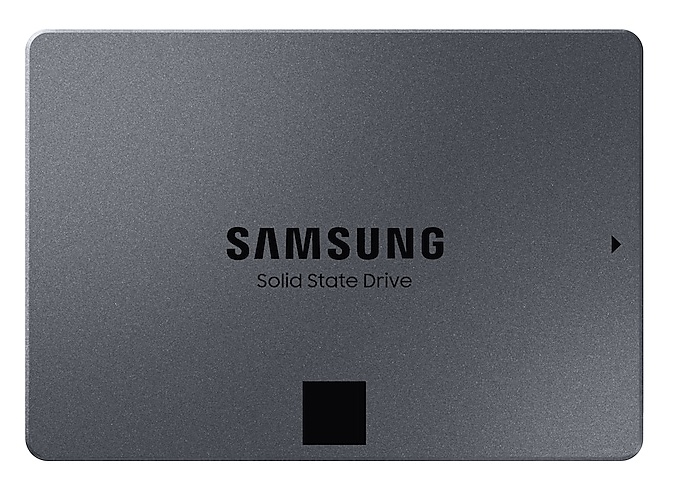
The Samsung 870 QVO 2 TB (MZ7M32T0HALC) stands out by combining Samsung V-NAND 4-bit QLC with near-SATA-limit performance at 560/530 MB/s and 98,000/88,000 IOPS, making it a strong fit for read-heavy bulk storage, content libraries, and capacity-focused client or edge deployments. Compared with MZ7LH1T9HALT0D3, it delivers a generational uplift in usable capacity from 1.92 TB to 2 TB while also improving peak SATA throughput, giving architects better density and a lower cost-per-terabyte in the same 2.5-inch SATA footprint.
With an endurance rating of 720 TBW and 0.33 DWPD, the MZ7M32T0HALC is well suited for typical read-centric and mixed business workloads, including OS boot, application hosting, office productivity, and light virtualization. In practical terms, for a 2 TB drive this level of endurance is generally more than sufficient for long-term system-disk use, and in many normal deployment scenarios it can support around a decade of everyday write activity without concern. From a reliability perspective, the specified UBER of 1.0E-15 means an exceptionally low probability of unrecoverable bit errors, helping support stable data integrity in enterprise environments, while the 1.5 million hour MTBF reflects strong expected operational reliability over time. This model does not include power-loss protection, so while it remains a dependable choice for controlled environments with stable power and system-level safeguards, workloads requiring write-in-flight protection during sudden outages should use platform-level power backup or consider a PLP-equipped drive.
1. The SATA interface enables straightforward drop-in deployment across existing enterprise storage backplanes, minimizing upgrade cost and integration risk.
2. Its near bus-saturating sequential read performance helps accelerate OS image loading, backup restores, and large-scale content distribution.
3. Strong random read capability improves responsiveness for VDI, web-scale caching, and metadata-heavy database queries under multi-user pressure.
4. Built with Samsung QLC V-NAND and a read-optimized endurance profile, it delivers lower cost per terabyte for warm data, content repositories, and other capacity-focused enterprise tiers.
5. Low typical latency supports tighter QoS, helping transactional applications and virtualized workloads stay responsive during sustained demand.
Reference capacities in the same series for MPN MZ7M32T0HALC (2 TB): Lower capacity: 960 GB Higher capacity: 3.84 TB Performance positioning: In this enterprise SATA series, sequential read/write and random IOPS are broadly similar across 960 GB, 2 TB, and 3.84 TB models, so capacity is the main differentiator rather than headline performance. Capacity positioning analysis: The 2 TB model sits in the sweet spot of this series. Compared with the 960 GB version, it offers much better headroom for OS images, logs, snapshots, and steady data growth, reducing the risk of early capacity pressure. Compared with the 3.84 TB option, it keeps acquisition cost and $/usable workload more balanced while delivering essentially the same enterprise-class throughput and latency profile. It is best suited for mid-scale deployments, such as a virtualization cluster serving about 40-60 general-purpose virtual machines or a compact database and application tier.
Q: Is MZ7M32T0HALC suitable for a write-heavy database server?
A: Generally no. With 0.33 DWPD, 720 TBW, and QLC NAND, MZ7M32T0HALC is better suited for read-intensive or mixed workloads rather than sustained write-heavy database server applications.
Q: How many full drive writes per day can it actually endure over its warranty period?
A: This model is rated for 0.33 DWPD, meaning about one-third of its 2 TB capacity can be written daily over the warranty period, equivalent to roughly 660 GB per day.
Q: Does it include power loss protection (PLP) and why is that critical?
A: No, it does not include PLP. Power loss protection is critical in enterprise environments because it helps prevent in-flight data loss and metadata corruption during unexpected power interruptions.
Q: What RAID level is recommended for this SSD?
A: For most deployments, RAID 1 or RAID 10 is recommended to improve redundancy and performance. RAID choice should still depend on workload, capacity targets, fault tolerance, and rebuild considerations.