











 Secure payments
Standard refund policy
Trade Assurance
Secure payments
Standard refund policy
Trade Assurance
| Brand | Samsung |
|---|---|
| Model | 870 QVO |
| Capacity | 4 TB |
| Usage Class | Client |
| Host Interface | SATA 6Gb/s |
|---|---|
| Total Interface Bandwidth | 6 Gb/s |
| Form Factor | 2.5 |
|---|
| NAND Flash | Samsung V-NAND 4-bit QLC |
|---|---|
| Drive Writes Per Day | 0.25 |
| Total Bytes Written | 1440 TBW |
| Sequential Read | 560 MB/s |
|---|---|
| Sequential Write | 530 MB/s |
| Random Read IOPS | 98000 |
| Random Write IOPS | 88000 |
| Average Latency | 130 μs |
| Mean Time Between Failures | 1.5 Million Hours |
|---|---|
| Uncorrectable Bit Error Rate | 1.0×10⁻¹⁷ |
| Power Loss Protection | No |
| MPN | MZ-76Q4T0BW |
|---|
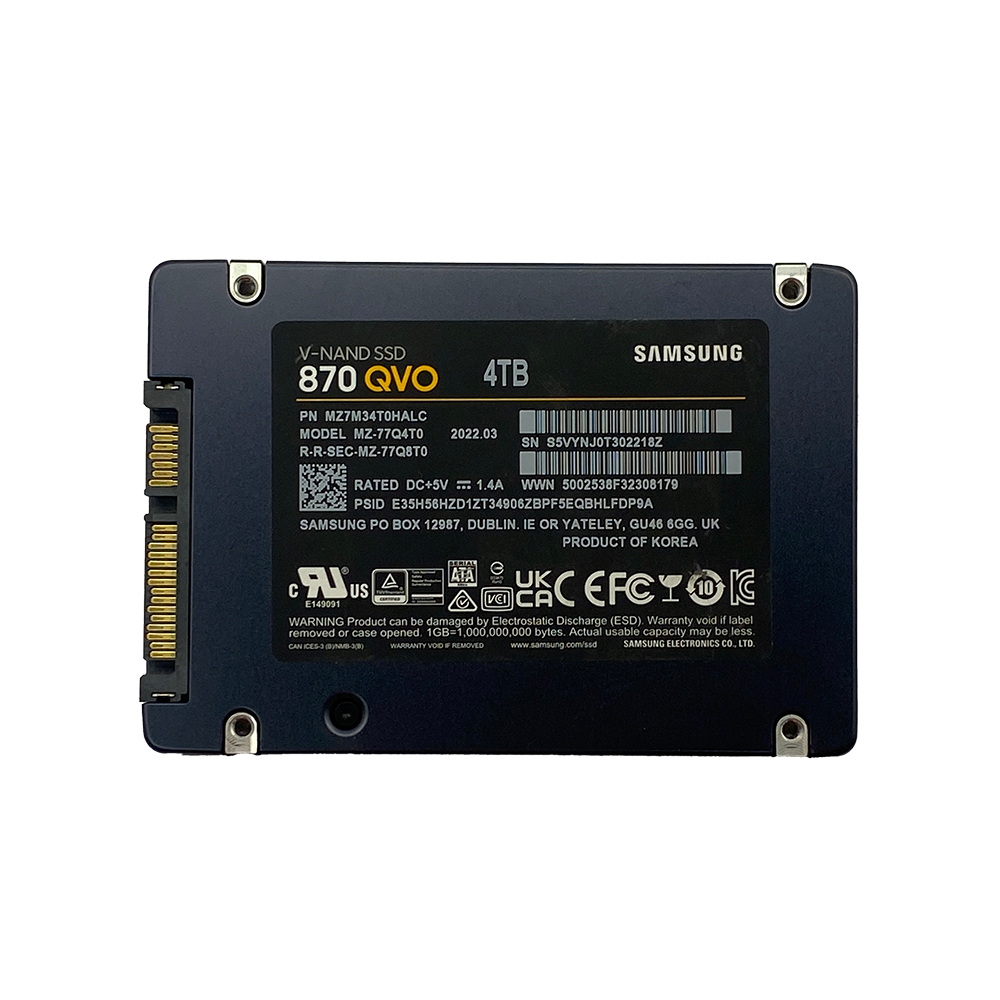
Compared with the MZ-76Q4T0BW, the MZ7M34T0HALC 870 QVO advances Samsung’s 4TB SATA QLC platform with higher peak sequential performance at 560/530 MB/s and up to 98,000/88,000 IOPS, making it a stronger fit for capacity-dense read-centric tiers and large media or backup datasets. Its 1,440 TBW endurance at 0.25 DWPD, combined with Samsung V-NAND 4-bit QLC, delivers a better balance of usable flash capacity, client-SATA saturation, and lifecycle value than the previous-generation part.
With an endurance rating of 1440 TBW and 0.25 DWPD, this SSD is well suited for read-intensive and mixed everyday workloads, allowing a very large amount of data to be written over its service life before wear becomes a concern. In practical terms, for typical OS, application, and light business data usage, it can comfortably serve as a system or boot drive for many years without endurance-related concern. An UBER of 1.0E-15 means the drive is designed to deliver a very low rate of uncorrectable read errors, which supports dependable data access in business environments. This model does not include power-loss protection, so it is best deployed in systems with stable power, UPS coverage, or non-cache-critical workloads where sudden power interruption is well controlled.
1. The SATA interface paired with near-bus-limit sequential read performance makes this drive a practical drop-in upgrade for legacy enterprise servers and storage arrays that need faster boot, restore, and bulk data access without moving to NVMe.
2. Its strong random read capability supports read-heavy virtualization, database, and content-delivery workloads by serving large volumes of small requests with consistent responsiveness.
3. The endurance rating is best suited to mostly read-oriented enterprise deployments such as boot volumes, media repositories, reference datasets, and scale-out cold storage where write pressure remains moderate.
4. Samsung’s V-NAND QLC architecture enables higher flash density and better cost efficiency, making it attractive for capacity-focused data center tiers that prioritize dollars per terabyte over sustained write intensity.
5. Low typical read latency helps reduce application wait time, improving user experience in transaction lookup, metadata access, and other latency-sensitive read paths.
Lower capacity reference: 1.92 TB Higher capacity reference: 7.68 TB Capacity positioning analysis: In this Samsung enterprise SSD family, the 4 TB model sits in a practical sweet spot. Compared with the 1.92 TB version, it provides much better headroom for data growth, denser VM placement, and fewer drive slots consumed at the same performance class. Compared with the 7.68 TB option, it typically delivers the best balance of acquisition cost, usable capacity, and predictable enterprise performance without overcommitting budget to unused space. It is especially well suited for mid-scale virtualization clusters, database nodes, and high-availability application servers.
Q: Is MZ7M34T0HALC suitable for a write-heavy database server?
A: Not ideally. With 0.25 DWPD, 1440 TBW, and QLC NAND, MZ7M34T0HALC is better suited for read-intensive or mixed workloads rather than sustained write-heavy database server applications.
Q: How many full drive writes per day can it actually endure over its warranty period?
A: This model is rated for 0.25 drive writes per day, meaning about one quarter of its 4 TB capacity can be written daily on average during warranty coverage.
Q: Does it include power loss protection (PLP) and why is that critical?
A: No, it does not include PLP. Power loss protection is critical in enterprise environments because it helps prevent in-flight data loss and metadata corruption during unexpected power failures.
Q: What RAID level is recommended for this SSD?
A: For this SSD, RAID 1 or RAID 10 is typically recommended when data protection and performance consistency matter. RAID 5/6 may add extra write stress on this lower-endurance drive.