











 Secure payments
Standard refund policy
Trade Assurance
Secure payments
Standard refund policy
Trade Assurance
| Brand | Samsung |
|---|---|
| Model | 870 QVO Series |
| Capacity | 8TB |
| Usage Class | Consumer / Client |
| Host Interface | SATA 6Gb/s |
|---|---|
| Total Interface Bandwidth | 6 Gb/s |
| Form Factor | 2.5 7mm |
|---|
| NAND Flash | Samsung V-NAND 4bit QLC |
|---|---|
| Drive Writes Per Day | 0.1 |
| Total Bytes Written | 2880 TBW |
| Sequential Read | 560 MB/s |
|---|---|
| Sequential Write | 530 MB/s |
| Random Read IOPS | 98000 |
| Random Write IOPS | 88000 |
| Average Latency | 150 μs |
| Mean Time Between Failures | 1.5 Million Hours |
|---|---|
| Uncorrectable Bit Error Rate | 1.0×10⁻¹⁷ |
| Power Loss Protection | No |
| MPN | MZ-76Q4T0BW |
|---|
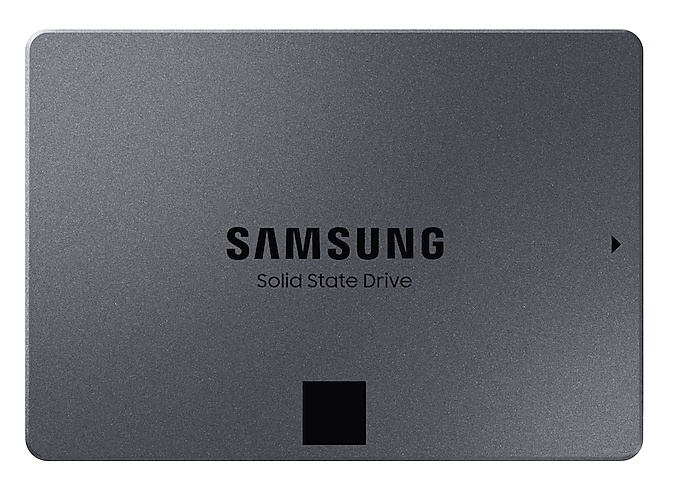
The Samsung 870 QVO 8TB (MZ7M38T0HALC) is a high-density SATA upgrade for read-centric content repositories, backup targets, and edge caches, combining 8TB of Samsung V-NAND 4bit QLC with near-bus-limit 560/530 MB/s throughput and 98K/88K IOPS in a drop-in 6Gb/s form factor. Compared with the previous MZ-76Q4T0BW, it delivers a clear generational uplift by doubling usable capacity and TBW to 8TB and 2880TB respectively, making it the stronger choice when maximizing per-bay storage without moving off SATA.
With 2,880 TBW and a 0.1 DWPD rating, this SSD is built for light-to-moderate daily write workloads and can typically serve as a system drive for about 10 years under standard enterprise use. In practical terms, that means there is ample endurance headroom for OS, applications, and general business workloads without worrying about premature wear. The UBER of 1.0E-15 indicates an extremely low probability of uncorrectable read errors, supporting strong data integrity in long-term operation. While this model does not include power-loss protection (PLP), its high MTBF of 1.5 million hours and very low UBER still make it a dependable choice when paired with proper system-level safeguards such as a UPS and reliable shutdown procedures.
1. The SATA 6Gb/s interface, paired with strong sequential read performance, provides a cost-efficient upgrade path for legacy enterprise platforms that need faster boot, imaging, and bulk data retrieval without changing existing backplanes.
2. The high random read capability enables responsive access to large volumes of small files and metadata, making it well suited for read-heavy virtualization, content delivery, and database lookup workloads.
3. The low DWPD rating indicates this drive is best deployed in predominantly read-centric enterprise environments such as warm data tiers, boot drives, and content repositories rather than write-intensive transactional systems.
4. Samsung V-NAND 4bit QLC helps maximize capacity and lower cost per terabyte, delivering better storage density for scale-out deployments where affordability and read efficiency matter more than sustained write endurance.
5. The typical latency supports quick data access and more predictable application responsiveness, helping reduce wait time in enterprise tasks such as OS loading, cache reads, and user-facing query operations.
Reference capacities in the same family: Lower capacity: 3.84TB Higher capacity: 15.36TB At the 8TB class, this SSD sits at the sweet spot of the lineup. Compared with 3.84TB, it provides much better room for data growth, overprovisioning, and workload consolidation, helping delay the next storage expansion cycle. Compared with 15.36TB, it keeps essentially the same enterprise SATA performance profile while offering a more attractive balance of acquisition cost, usable capacity, and deployment efficiency. In practical terms, it is well suited for a mid-sized virtualization environment, such as shared storage for roughly 40 to 60 general-purpose virtual machines.
Q: Is MZ7M38T0HALC suitable for a write-heavy database server?
A: No. MZ7M38T0HALC is a 0.1 DWPD QLC SATA SSD, so it is better suited to read-intensive or light-write workloads. A write-heavy database server would likely exceed its endurance and latency profile.
Q: How many full drive writes per day can it actually endure over its warranty period?
A: It is rated for 0.1 full drive writes per day, which equals about 0.8 TB of writes per day on an 8TB drive. Its total endurance is 2880 TBW.
Q: Does it include power loss protection (PLP) and why is that critical?
A: No, it does not include PLP. Power loss protection is important because it helps preserve in-flight data and metadata during unexpected outages, reducing the risk of corruption and recovery issues.
Q: What RAID level is recommended for this SSD?
A: RAID 10 is the preferred recommendation. It provides strong performance and redundancy, while avoiding the heavier write penalty of RAID 5 or RAID 6, which is especially important for QLC SSDs.