











 Secure payments
Standard refund policy
Trade Assurance
Secure payments
Standard refund policy
Trade Assurance
| Brand | Samsung |
|---|---|
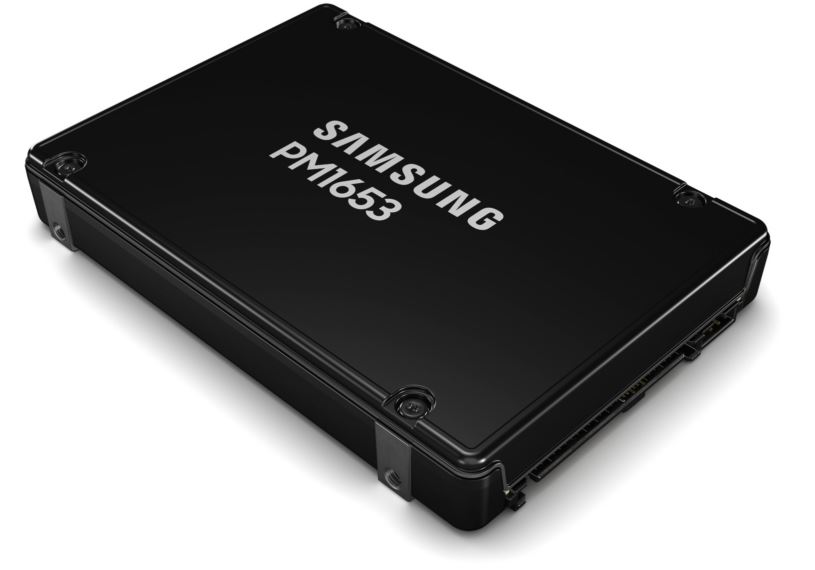
| Model | PM1653 |
| Capacity | 3.84 TB |
| Usage Class | Enterprise/Mixed-Use |
| Host Interface | SAS 24Gb/s |
|---|---|
| Total Interface Bandwidth | 24 Gb/s |
| Form Factor | 2.5 inch 15mm |
|---|
| NAND Flash | Samsung V6 (128L) TLC |
|---|---|
| Drive Writes Per Day | 3 |
| Total Bytes Written | 21024 TBW |
| Sequential Read | 4300 MB/s |
|---|---|
| Sequential Write | 3800 MB/s |
| Random Read IOPS | 800000 |
| Random Write IOPS | 270000 |
| Average Latency | 95 μs |
| Mean Time Between Failures | 2.5 Million Hours |
|---|---|
| Uncorrectable Bit Error Rate | 1.0×10⁻¹⁷ |
| Power Loss Protection | Yes |
| MPN | MZILG3T8HCLS-00007 |
|---|
Compared with the earlier MZILG3T8HCLS-00007, the MZILG3T8HCLS-00A07 PM1653 refresh leverages 24Gb/s SAS and Samsung V6 128-layer TLC to deliver higher-performance headroom in the same 3.84 TB, 3 DWPD class, reaching up to 4,300/3,800 MB/s and 800K/270K IOPS. Its 21,024 TBW endurance makes it a strong fit for tier-1 OLTP databases, virtualization clusters, and mixed read/write enterprise storage pools that need SAS compatibility without sacrificing flash throughput.
With a rated endurance of 21,024 TBW and 3 DWPD, this SSD is built for heavy enterprise use and can sustain continuous daily writes far beyond a typical client drive. Under normal mixed workloads, this level of endurance is sufficient for long-term deployment as a system drive, with roughly 10 years of worry-free operation in many standard usage scenarios. Its power-loss protection (PLP) helps preserve in-flight data during unexpected shutdowns, reducing the risk of corruption and improving data integrity in critical systems. The extremely low UBER of 1.0E-17 means uncorrectable read errors are exceptionally rare, and together with the 2.5 million-hour MTBF, it reflects a highly reliable enterprise-class SSD platform.
1. The SAS 24Gb/s interface, paired with 4.3 GB/s sequential read bandwidth, enables faster backup, restore, and large-dataset streaming in mission-critical enterprise storage arrays.
2. With up to 800K random-read IOPS, the drive can sustain highly concurrent OLTP, virtualization, and metadata-heavy workloads without becoming a bottleneck.
3. A typical read latency of 95 µs helps reduce application response time, improving consistency for latency-sensitive databases and real-time analytics platforms.
4. Rated for 3 DWPD, this SSD is built for write-intensive enterprise use, giving operators the endurance headroom needed for logging, caching, and mixed-workload deployments over its service life.
5. Samsung V6 128-layer TLC NAND delivers a strong balance of density, performance, and cost efficiency, making it well suited for scalable data center deployments that need predictable reliability.
Lower capacity reference: 1.92 TB Higher capacity reference: 7.68 TB At 3.84 TB, this SSD sits at the sweet spot of the family. Compared with the 1.92 TB option, it gives noticeably more headroom for VM growth, log retention, and data set expansion without changing the expected enterprise-class throughput and IOPS profile. Compared with the 7.68 TB model, it delivers a better balance between acquisition cost, usable capacity, and performance consistency. It is especially well suited for mid-scale virtualization clusters, such as hosting boot and application volumes for about 40 to 60 general-purpose virtual machines.
Q: Is MZILG3T8HCLS-00A07 suitable for a write-heavy database server?
A: Yes. With 3 DWPD, 21,024 TBW, SAS 24Gb/s, and 95 µs latency, MZILG3T8HCLS-00A07 is well suited for write-heavy database workloads, though extremely high-write environments should still be monitored.
Q: How many full drive writes per day can it actually endure over its warranty period?
A: It is rated for 3 full drive writes per day over its warranty period. For a 3.84 TB drive, that equals about 11.52 TB of writes per day, or 21,024 TBW total.
Q: Does it include power loss protection (PLP) and why is that critical?
A: Yes, it includes power loss protection (PLP). PLP helps preserve in-flight data and metadata during sudden outages, reducing corruption risk and improving consistency for databases and other transactional systems.
Q: What RAID level is recommended for this SSD?
A: For this SSD, RAID 10 is typically recommended in enterprise servers because it combines strong read/write performance with redundancy. If capacity efficiency is prioritized, RAID 5/6 may be considered, but write-heavy databases usually favor RAID 10.