











 Secure payments
Standard refund policy
Trade Assurance
Secure payments
Standard refund policy
Trade Assurance
| Brand | Samsung |
|---|---|
| Model | PM9A1 |
| Capacity | 2 TB |
| Usage Class | Client/OEM High-Performance |
| Host Interface | PCIe 4.0 x4, NVMe |
|---|---|
| Total Interface Bandwidth | 64 Gb/s |
| Form Factor | M.2 80mm (2280) |
|---|
| NAND Flash | Samsung V6 (128L) TLC |
|---|---|
| Drive Writes Per Day | 0.3 |
| Total Bytes Written | 1200 TBW |
| Sequential Read | 7000 MB/s |
|---|---|
| Sequential Write | 5200 MB/s |
| Random Read IOPS | 1000000 |
| Random Write IOPS | 850000 |
| Average Latency | 80 μs |
| Mean Time Between Failures | 1.5 Million Hours |
|---|---|
| Uncorrectable Bit Error Rate | 1.0×10⁻¹⁷ |
| Power Loss Protection | No |
| MPN | MZVLB2T0HBLB-00000 |
|---|
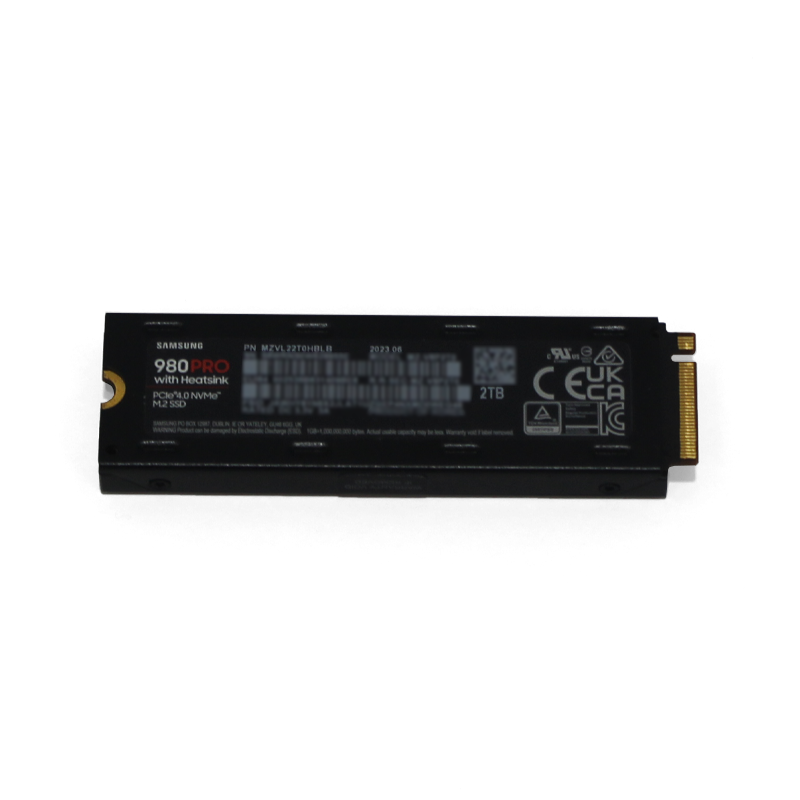
Compared with the previous-generation MZVLB2T0HBLB-00000, the Samsung PM9A1 2 TB (MZVL22T0HBLB-00BD1) makes a clear platform leap to PCIe 4.0 x4, delivering up to 7000/5200 MB/s and 1,000,000/850,000 IOPS for markedly faster sequential and mixed random workloads. Built on Samsung V6 128-layer TLC with 1200 TBW endurance, it is a strong choice for high-performance client workstations and read-intensive edge servers that need flagship throughput without moving to a higher-DWPD enterprise drive.
With an endurance rating of 1200 TBW, this SSD can sustain roughly 330 GB of host writes per day for 10 years, which is more than sufficient for a typical OS drive, boot device, or other read-heavy business workload. Its 0.3 DWPD rating further confirms that it is well suited for mainstream commercial use where daily write volume is moderate and predictable. In reliability terms, the specified UBER of 1.0E-15 means an uncorrectable bit error is statistically expected only once per 10^15 bits read, providing a solid level of data integrity for normal enterprise and professional applications. This model does not include power-loss protection (PLP), so while it is dependable for standard workloads, it is best deployed in systems with stable power or higher-level data protection if write-in-flight protection during sudden outages is a requirement.
1. The PCIe Gen4 x4 NVMe architecture unlocks host-side bandwidth that keeps analytics clusters, virtualization nodes, and AI servers fed without storage becoming the bottleneck.
2. Its class-leading sequential read capability sharply reduces dataset staging, VM boot, and large-file scan times in read-heavy enterprise workflows.
3. The very high random read performance enables dense transaction processing, metadata lookups, and large-scale VDI environments to sustain fast response under heavy concurrency.
4. This endurance profile is best aligned with read-centric enterprise deployments, offering cost-efficient reliability for content delivery, caching, and scale-out storage tiers.
5. Built on Samsung’s mature high-layer TLC NAND, the drive balances capacity, power efficiency, and predictable quality for hyperscale and datacenter operation.
Lower capacity reference: 960 GB Higher capacity reference: 3.84 TB At 2 TB, this SSD sits in the sweet spot of the series. Compared with the 960 GB model, it gives materially better headroom for OS images, application stacks, logs, and growth, reducing the risk of early capacity pressure in always-on enterprise environments. Compared with the 3.84 TB option, it preserves most of the same practical performance profile while offering a more efficient acquisition cost and better budget density per node. It is best suited for medium-scale deployments, such as a 3-node virtualization cluster or a compact database and analytics tier.
Q: Is MZVL22T0HBLB-00BD1 suitable for a write-heavy database server?
A: Not ideally. With 0.3 DWPD and 1200 TBW, this 2 TB TLC NVMe SSD is better suited for read-intensive or mixed workloads rather than sustained write-heavy database environments.
Q: How many full drive writes per day can it actually endure over its warranty period?
A: Its endurance rating is 0.3 DWPD, meaning it supports about 0.3 full drive writes per day. For a 2 TB drive, that equals roughly 600 GB of writes daily.
Q: Does it include power loss protection (PLP) and why is that critical?
A: No, it does not include PLP. Power loss protection is critical in enterprise systems because it helps prevent in-flight data loss and reduces metadata corruption during unexpected power failures.
Q: What RAID level is recommended for this SSD?
A: For performance and redundancy balance, RAID 1 or RAID 10 is commonly recommended. For read-focused deployments, RAID 5 may be considered, but write-heavy workloads should prefer RAID 10.